Please note: |
|---|
In the assignment, the processes / work contents are distributed to the stations or operators. |
Assignment by Takt mode
▪Assignment in the Standard Balancing
▪Assignment in the Mixed Balancing
▪Assignment in the Max-Balancing
Work with assignments
▪Display options in the Assignment diagram
▪
The "Assignment" tab consists of four areas:
▪Assignment area left: Tree view
▪Assignment area right: Graphic/Chart
▪Work Contents
▪Ergonomics (if elements with EAWS evaluations are used as work contents)
Assignment tab

Assignment tab
The order of the assigned work contents in the graphic should be read from bottom to top. In the tree view, however, the order is to be read from top to bottom .
Context menu in the Assignment Section
Right-click on an element to open the context menu.

Entry |
Meaning |
|---|---|
Assign |
Assign element to selected operator |
Copy |
Copy element |
Cut |
Cut element |
Insert |
Insert element before or after current row |
New row |
Insert new row |
Delete row |
Delete selected row |
Open |
Open element, reference, or folder |
Document 1/2/3 |
Add document |
Search element |
Open search dialog |
Columns of the tree view in the assignment:
Click on the Select columns button to open a menu that allows you to show and hide the desired columns. Which columns are available is determined by the settings made in the administration.

Column |
Explanation |
|---|---|
Code |
Code of the element |
Index |
Index of the element |
Variant |
Variant of the element |
Description |
Description of the element |
S (standard text indicator) |
The S column for identifying standard text can optionally be displayed. This standard text indicator does NOT refer to the original element, but to the text in the work contents when a text is changed by renaming it in the assignment. |
Type |
Element type |
tg |
Time of the element (e.g. tg) from TiCon Base Please note: The time type that is set in the element configuration in the administration is displayed. |
Load |
Load percentage of operator / station |
Factor |
Factor, with which the element time within a balancing is multiplied, e.g. to indicate a proportional usage of the element. |
tg total |
Total time |
Pieces |
Number of workpieces Input mode: Number of pieces according to the settings in the Workplace organization tab Please note: In the mix balancing, the number of pieces comes from the total quantity of the respective variant entered in the Variants tab. |
tg total * pieces |
Total time * number of pieces |
∑ tg total |
Sum of times |
∑ tg total * pieces |
Sum of times * number of pieces |
Criteria |
Assigned criteria |
Value added |
Assigned indicators |
Category |
Assigned category |
Tags |
Assigned tags |
Comment |
Assigned comment |
Type |
Type of the element |
Status |
Assigned status |
G (global element) |
The element is a global element. |
X (Exclusive usage) |
A station can only be occupied by one worker at a time. |
Product variants |
Product variants to which the element is assigned |
Variant keys |
Variant key of the product variants to which the element is assigned |
Dependencies |
Dependencies (predecessor/successor) |
Color |
Assigned color |
Picture 1/2/3 |
Assigned picture(s) |
Document 1/2/3 |
Assigned document(s) |
The Edit button in the Assignment ribbon can be used to change the factor for element rows. Furthermore, you can add a cycle time and station factor for the station rows.
Variables can also be used to define the factor. To do this, the use of factors must be selected in the element configuration.
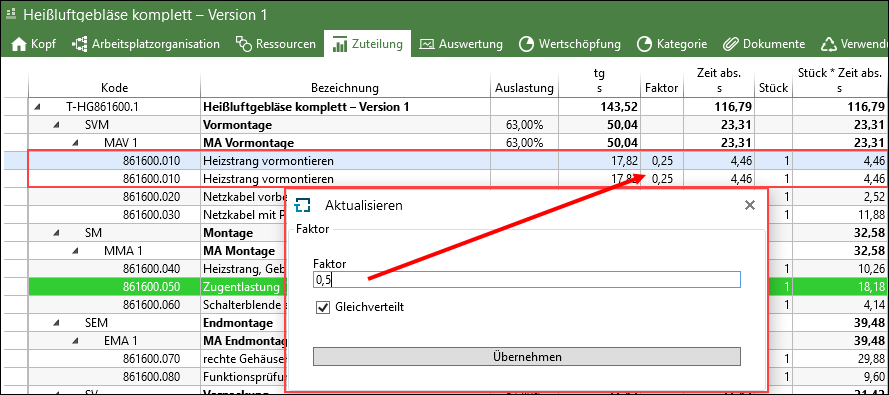
Element factor:
Input field where the factor of an element or of several highlighted elements can be overwritten. It is possible to add a numeric factor to several rows.
There are the following options:
▪Evenly distributed: Elements with the same occurrence in the balancing are divided in such a way that the factor in sum is equal to the entered value. If, for example, the factor 1 is entered with two occurrences, the factor 0.5 results; for 3 occurrences, the factor is 0.33333 etc. It is sufficient to highlight one occurrence of the element, but it is also possible to highlight several. The value entered in connection with Evenly distributed is divided by the number of occurrences. If Evenly distributed is not active, the entered factor value is applied to all selected rows.
▪Apply for all variants: If this option is active, the change affects all variants. If the option is inactive, only the currently displayed variants are affected.
Cycle time/Station factor:
These factors are used to map identical work contents at stations. Factors other than 1 are displayed at the station in the Factor column. Either the cycle time factor or the station factor per station can be used. To enter a cycle time/station factor, select the desired station and use Assignment > Edit > Factor on the ribbon.
Cycle time factor At this station, one worker moves along for n cycles (= rotating station).
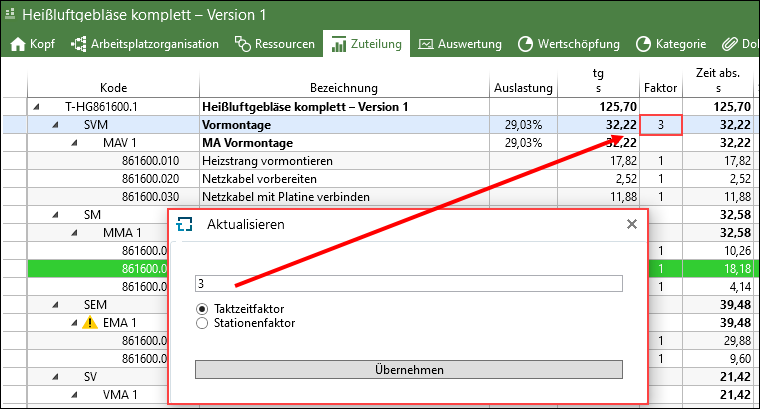
The cycle time of 37 s was multiplied by 3
Station factor: The times of all assigned elements are virtually divided. For example, with a factor of 2, the time of the assigned work contents is halved.
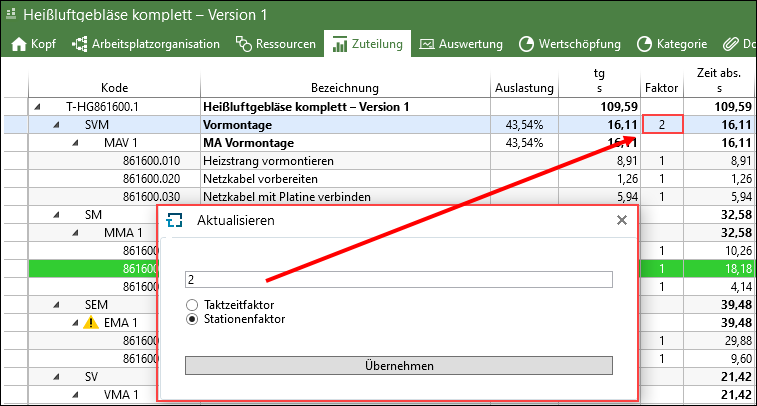
The element time of 32,22 s was divided by 2.