The data card designer has an own ribbon with different insert options and configuration options:

Ribbon Data card
Area Row / Column
Symbol |
Option |
Function |
|---|---|---|
 |
Add row / column |
Inserts a new row / column at the end of the table. |
 |
Delete row / column |
Deletes the selected row / column from the data card. |
 |
Autofit row height / column width |
Distributes the row height / column width of all selected rows / columns evenly without changing the total height or width. You have to select e.g. one block of cells one above the other and then choose the option Autofit row height in the ribbon. |
Area Cell
Symbol |
Option |
Function |
|---|---|---|
 |
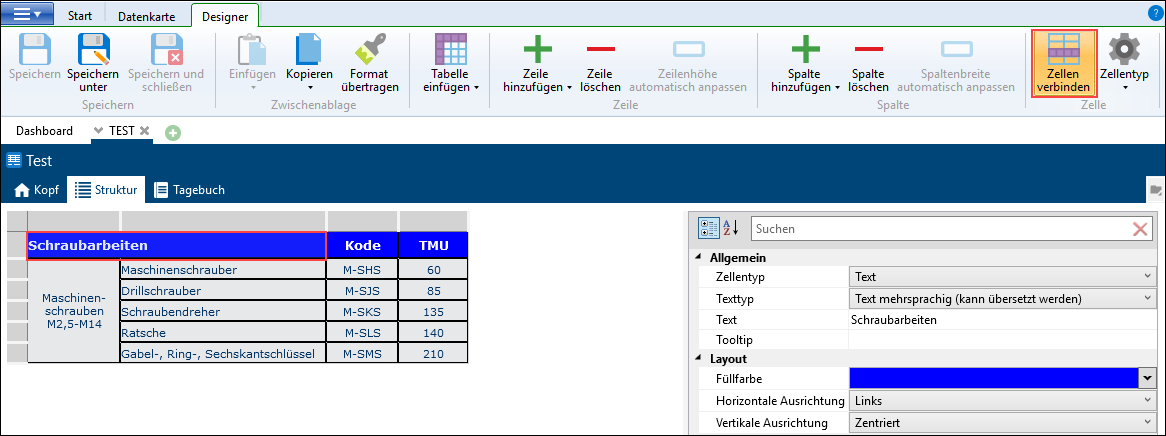
Merge cells |
This option is only active if more than one cell is selected which can be connected to another cell. If it is a merged cell, it can be split into the original number of cells by clicking the "Merge cells" button. |
 |
Cell type |
Changes the selected cell type. Depending on the selection, there are different layout settings available. |
After you have inserted a table and click in any cell, the properties dialog opens in the right part of the designer. The width of this dialog can be adjusted depending on requirements. Different properties are available depending on the cell type. These can either be entered using drop-down selection or manually.
Available settings for the properties:
General
▪Cell type, text type (Selection for maintaining multilingual texts), text and tooltip
Please note: |
|---|
When entering text, it is possible to enter line breaks in one line by pressing the Enter key or inserting a line break from the clipboard. |
Layout
▪Fill color, horizontal and vertical alignment of the text
Frame
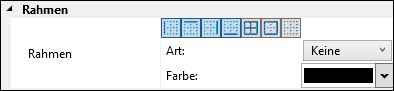
▪Button: Frame border left, above, right, below, all frame borders, frame borders outside, no frame
▪Type and color of framing lines
Please note: |
|---|
The type of frame border is set to "None" by default after the data card has been opened for editing. If a frame border is required, first select a frame type. Borderlines can also be added or removed after selecting multiple cells. |
Font
▪Font, size, type and text color
Column
▪Column type and height
Line
▪Row type and height
Please note: |
|---|
If percent is selected as the column/row type, please ensure that all rows/columns add up to 100%. Otherwise, TiCon fills the remaining space at its own discretion. |
Further hints:
Merge cells
Please note: |
|---|
Ensure that the data to be displayed in the merged cell is located in the upper-left cell of the marked area. Only the data in the left upper cell remains in the merged cell. The data of all other cells in the marked area is deleted. |
1.Mark two or more adjacent cells to be merged.
2.Click Merge cells in the ribbon Data card in the group "Row".
Cell type
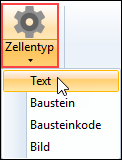
The cell format can be selected in the ribbon using the "Cell type" button. The type can also be changed in the settings under "General".
Four types are available:
Instructions for use:
1.of times
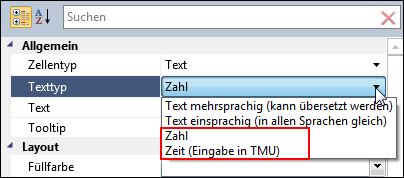
If "Number" is selected under "Text type", the value entered in the data card is fixed. If you select "Time (in TMU)", the value must be entered in TMU. The times on the data card are converted accordingly when the time is changed, provided the option "Times respond to time converter" is active in the header. If the option is not activated, the times are displayed according to the time unit and decimal places set in the header.
The "Picture" or "Element" option must be defined as the cell type.
Picture files can be integrated by specifying the path name row in the "Properties" dialog. You can also select the location of the image file by clicking the "  " button. The following file formats are supported: *.bmp, *.jpeg, *.gif, *.tiff, *.png, and *.svg.
The pictures are copied into the TiCon database during import.
Please note: |
|---|
It is possible to maintain one tooltip per data card cell. |