These settings are available for the element configurations of the "Balancing" [BL] and "Mix balancing" [MB] element types – with the special feature that a maximum balancing can be defined as a mode of operation within the "Mix balancing" type.

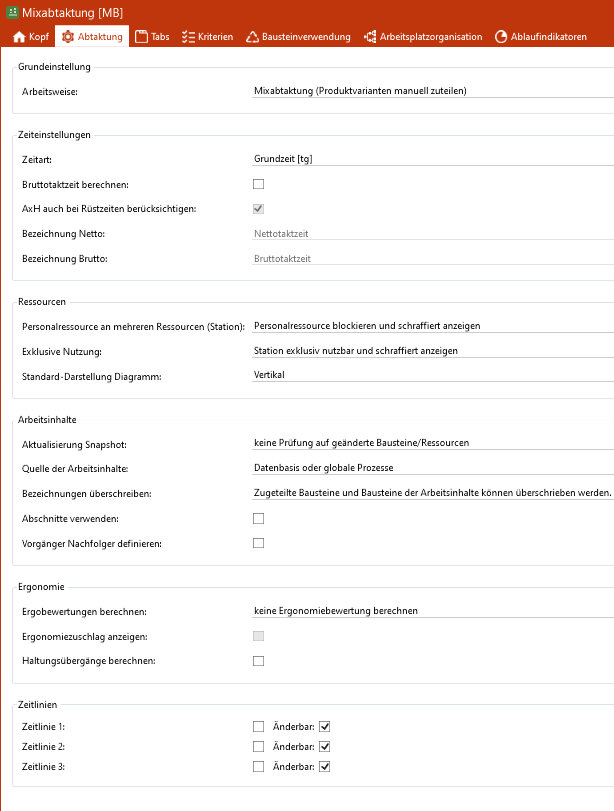 The "Balancing" tab in the element configuration of a "Mix balancing" |
Defines the mode of operation in the assignment. In a standard balancing, the option "Standard (without product variants)" is selected and cannot be changed In a mix balancing, the options "Mix balancing (assign product variants manually)" and "Maximum balancing (assigning the maximum variant)" can be selected. |
Time type Defines the time type that will be used for the balancing. All time types are supported in all three balancing types.
Time evaluation In balancings with the maximum balancing working mode, you can switch between two modes for time evaluation: a)One common time value b)Time types tm, ttm, tt More about this: Time evaluation for multiple station work Calculate gross cycle time Selecting or deselecting the automatic calculation of the gross cycle time Consider quantity and frequency also with set-up times Selecting and deselecting the consideration of QxF for set-up times. Description Net Input field for custom description of the net cycle time Description Gross Input field for custom description of the gross cycle time |
Human resource on several resources (Stations) A human resource, i.e. an operator, can work at different stations. To do this, the human resource must have the same code. Since the operator cannot work simultaneously at two different stations, it makes sense to display the time at the corresponding other station as blocked. The following settings are available for this:  If a human resource / floater works at different stations (across stations), the processes in the tree are displayed in grey and italic, and in the diagram they are displayed in red or as a gap. Exclusive usage If two or more human resources work at one station, you can set that this station may only be used by one human resource (= exclusive) at a time. This means that only one operator can be working there at a time and the station is closed to others during this time. The processes in the tree are displayed in gray and italic. In the diagram, they are displayed in green or as a gap. In addition, the checkbox in the "X (Exclusive usage)" column of the "Resources" tab of the station must be activated for this functionality to be available. Default setting: Stations cannot be used exclusively  Standard display diagram: Choice between horizontal and vertical display of the tree Default setting: Vertical |
Update snapshot The "Update snapshot" setting can be used to set how the data basis is updated when a balancing is opened for each element configuration. Default setting: no check for changed elements / resources  Automatic refresh of balancings can be set at the element configuration.
Source of work contents Various data can be selected as the source of work contents: 
Overwrite descriptions The descriptions of assigned elements and/or the elements in the work contents can be overwritten depending on the settings. It is also possible to completely prohibit overwriting. Default setting: Assigned elements and elements in work contents can be overwritten. 
Use sections If the function is active, when using a data basis, elements from the data basis that have sections are displayed as split into sections in the work contents. The section factor specified in the structure of the parent element is also taken into account in the balancing. Define predecessor successor If the function is active, it is possible to define dependencies within a line balance. Here, parallel processes can start and end at the same time or start depending on another one afterwards. This creates a dependency to other operators/stations. Define simultaneity If this function is active, it is possible to define simultaneity with another resource (operator/machine) for one or more assignments.
|
|
Default setting: do not calculate ergonomic evaluation 
Performance level active Activation of the use of a performance level If a performance level is defined, the time corrected according to the performance level is used to calculate the EAWS evaluation. The performance level of the line balancing is always used, regardless of the settings made in the process element. The time of the assignments is reduced according to the performance level. The following applies: tg for Balancing= (tg - ttu - trtu) / performance level + ttu + trtu
Display Ergonomics allowance The "Display ergonomics allowance" function can only be activated if one of the two options "Calculate EAWS® evaluation" or "Aggregate EAWS® evaluation" has been selected for "Calculate ergo evaluations". If the ergonomics allowance display is active, a factor is calculated for each human resource based on their total ergo points and added to the time of the assigned elements. Calculate posture transitions If this function is active, posture transitions are calculated for HWD elements and elements ergonomics evaluation. These are displayed in a separate row generated by the program. More about this: Posture transitions |
Time line 1-3 Additional lines can be displayed when assigning a balancing. Three of these lines can be preset in the administration for each element configuration. If "Changeable" is active, the pre-set values can be changed in the "Assignment" tab of the application via the "Display options" button in the "Assignment" ribbon. The lines can be defined as follows: •Description – custom description •Color – color of the displayed lines •Calculation type / Value: •relative: The line is displayed for the indicated value (as percentage). •absolute: The line is displayed for the indicated value (in the set time unit)  Example of a time line at 95%, which cannot be changed in the assignment. |