The Variants tab shows the variants assigned to a balancing.
In addition, it enables the assignment of new product variants with the associated variant keys for mix and maximum balancing and the definition of numbers of pieces for the respective variant.

"Variants" tab in a maximum balancing
Availability of resources
For a variant, you can specify whether a resource should be available or not.
Edit variants
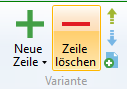
The following buttons in the Variants ribbon are used for adding or removing product variants in a balancing:
Button |
Function |
|---|---|
 |
Already created product variants are added in a new row. |
 |
Creates a new product variant and inserts it. |
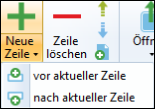 |
Creates a new product variant and inserts the corresponding row above or below the current row. |
 |
Deletes an inserted product variant. |
 |
Moves the selected product variant(s) one row up or down. |
Open/Duplicate variants
Product variants can be opened or duplicated using the "Open" and "Duplicate" buttons in the "Variants" ribbon.

"Open" and "Duplicate" buttons
Open variants
After pressing the "Open" button, a menu opens that allows you to make a selection:
▪Open a product variant element
▪Open the "Reference" tab in the element
▪Open the file folder

Opened selection menu
Duplicate variant
Case 1:
If a product variant is duplicated, a dialog appears that allows you to make various adjustments. It is advisable to adjust the variant key directly in this dialog so that you can work with the element immediately afterwards.
Case 2:
If a variant that is part of a product family is duplicated, a selection dialog appears after clicking "Next", which allows you to assign features to the duplicated product variants. A new variant key is generated from the selection made.

1. Case: Duplicate a variant without an assigned product family

2. Case: Duplicate a variant with an assigned product family Selection of features
Assignments that have already been made are also transferred when a variant is duplicated.
When duplicating global product variants, the total number of pieces and cycle time specification are also transferred.
Numbers of pieces
In the Quantity column, you can specify the number of pieces produced per variant. The Weighting column is grayed out because this value is calculated internally by the program.

"Number of pieces" and "Weighting" columns in the "Variants" tab
Production quantity
In the "Production Quantity" group of the ribbon, you can configure settings for the number of pieces and weighting.
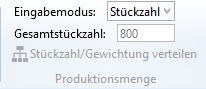
Group production quantity in the Ribbon
In the Input Mode drop-down menu, you can choose between Quantity and Weighting.
Mode Weighting
If the Weighting mode is enabled, you can enter a quantity with up to 5 decimal places in the Total Quantity field.
The weighting for each variant is entered in the Weighting column. The value you enter can have up to three decimal places.
The quantity of a variant is calculated as the product of the total quantity and the weighting. This value is calculated automatically by TiCon and contains a maximum of 5 decimal places.
Please note: |
|---|
If no variants exist yet, the Total Quantity field is populated with the Number of Cycles value from the workplace organization. If the calculated total quantity does not match the number of pieces specified in the workplace organization, a warning message appears. In this case, the total quantity of variants or the shift duration/cycle time must be adjusted. |
Mode number of pieces
If Quantity mode is enabled, you can enter a value in the Quantity column for each variant separately. In this case, the Weighting column is not available.
The total quantity is calculated as the sum of the numbers of pieces of all variants. The weighting of each single variant is calculated based on the ratio of the number of pieces of that variant to the total quantity.
Distribute number of pieces
If you want to distribute a number of pieces evenly across several variants, the "Distribute number of pieces" function is recommended. This becomes active in the ribbon if several variants are selected in the "Variants" tab.

"Distribute number of pieces" button
Input mode "number of pieces"
In the dialog that appears after pressing the button, you can enter the desired total number of pieces. Numerical values with up to 15 decimal places are permitted. The total number of pieces is distributed evenly among all variants.
Input mode Weighting
In the dialog that appears after pressing the button, you can enter the desired total number of pieces. This is distributed evenly among all variants.
Numbers of pieces
In the Number of pieces column, you can specify the number of pieces produced per variant. The "Weighting" column is grayed out, as this value is calculated internally in the program.
"Number of pieces" and "Weighting" columns in the "Variants" tab
Production quantity
In the "Production Quantity" group of the ribbon, you can configure settings for the number of pieces and weighting.
Group production quantity in the Ribbon
In the Input Mode drop-down menu, you can choose between Quantity and Weighting.
Mode Weighting
If the Weighting mode is enabled, you can enter a quantity with up to 5 decimal places in the Total Quantity field.
The weighting for each variant is entered in the Weighting column. The value you enter can have up to three decimal places.
The quantity of a variant is calculated as the product of the total quantity and the weighting. This value is calculated automatically by TiCon and contains a maximum of 5 decimal places.
Please note: |
|---|
If no variants exist yet, the Total Quantity field is populated with the Number of Cycles value from the workplace organization. If the calculated total quantity does not match the number of pieces specified in the workplace organization, a warning message appears. In this case, the total quantity of variants or the shift duration/cycle time must be adjusted. |
Mode number of pieces
If Quantity mode is enabled, you can enter a value in the Quantity column for each variant separately. In this case, the Weighting column is not available.
The total quantity is calculated as the sum of the numbers of pieces of all variants. The weighting of each single variant is calculated based on the ratio of the number of pieces of that variant to the total quantity.
Distribute number of pieces
If you want to distribute a number of pieces evenly across several variants, the "Distribute number of pieces" function is recommended. This becomes active in the ribbon if several variants are selected in the "Variants" tab.
"Distribute number of pieces" button
In "number of cycles" mode
In the dialog that appears after pressing the button, you can enter the desired total number of pieces. Numerical values with up to 15 decimal places are permitted. The total number of pieces is distributed evenly among all variants.
Input mode Weighting
In the dialog that appears after pressing the button, you can enter the desired weighting of pieces. This is distributed evenly among all variants.