The EAWS® structure of the EAWS® analysis forms the core of EAWS®. All relevant information on the execution conditions of the individual work steps is entered here. The workflow is entered with all ergonomic influencing factors. Every row is equivalent to one work step / body posture.
Please note the following changes: Changes in Version 4.10

EAWS-Struktur of a detailed analysis / detail view
In order to keep the window well organized, only the deviations compared to the default settings are displayed in the table. An empty row does not imply that no value has been entered, but that the default value has not been changed and is used for the calculations. Standard values are always ergonomically acceptable values.
The operations of the right or left side of the body are displayed in separate columns.
Note: |
|---|
▪The brush function can be used to quickly transfer values of individual cells from one row to other selected rows. For details, see “Brush function" ▪As with the structure of process elements, the temporary subtotal is also shown in the "EAWS® structure" tab in the status bar. |
Left + right combined

Left + right combined
Clicking on the "Left + right combined" button in the "EAWS® structure" ribbon activates the simple view. The simple view offers a compact view which makes it easier to see all values at once. However, it is not possible in this view to evaluate the right and left upper limb differently for the same work step (e.g. left 2 kg and right 3 kg of weight).
The "Active hand" column is displayed in the EAWS® structure in addition to "Mode of grasping", "Reach", "Finger forces", "Arm force", "Upper limbs", and "Manual load handling", although these columns are only displayed once, unlike the detailed view.
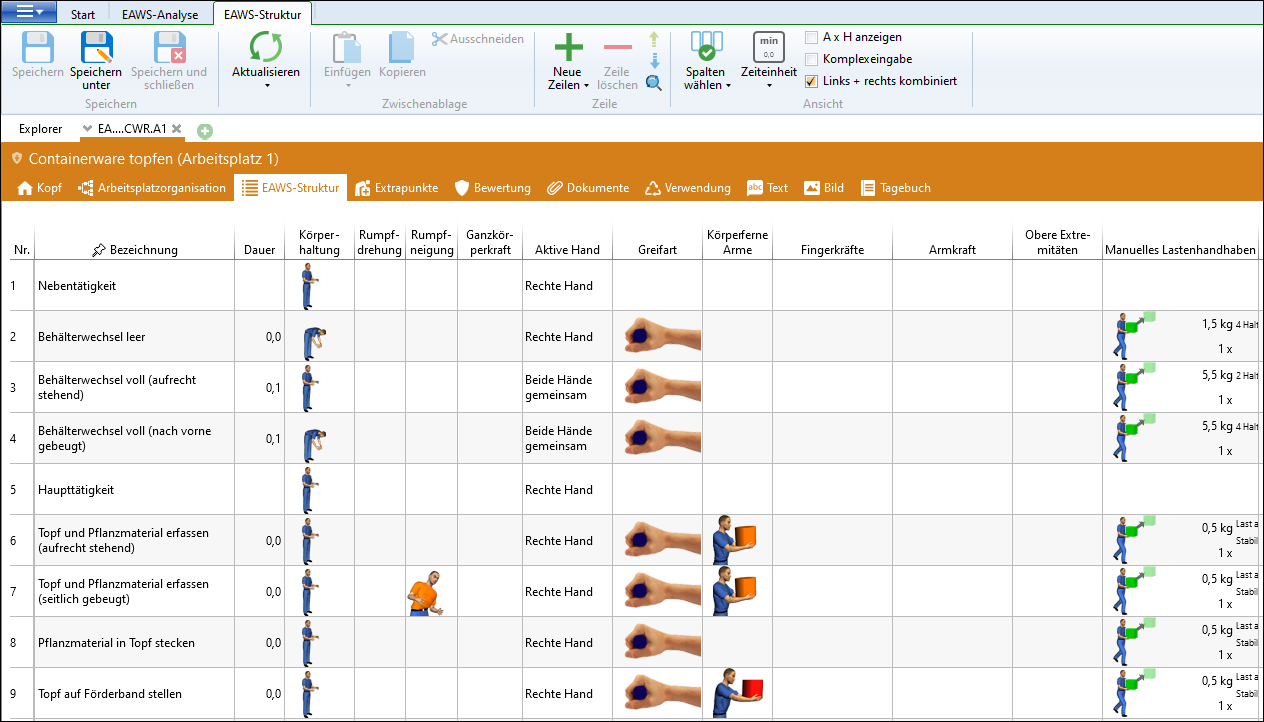
Simple view
Notes on using the "Active Hand" column
The "Active hand" column controls where the values for the "Mode of grasping", "Reach", "Finger forces", "Arm force", "Upper limbs", and "Manual load handling" columns are entered in the detail view.

▪Left hand --> all values are entered accordingly on the left
▪Right hand --> all values are entered accordingly on the right
▪Both hands together --> all values are entered left and right additionally the column one object is active
▪Both hands together --> all values are entered left and right additionally the column one object is not active
▪Left/Right different --> This indicates that different values have been entered for the left and right upper limb in the detailed view. These values cannot be displayed in the simple view. Switch the view to display right and left in separate columns and change the data if required.
Use of Parallelism
If parallelism is used in the building block structure (column P), a corresponding EAWS® structure row is created for each parallelism row.
No ergonomic data can be entered for the excluded structure rows (i.e., for the rows whose times are not included in the time calculation due to parallelism).
Use of Sections
If sections are used in the building block structure, an "EAWS"®sub-structure line is generated, under which the lines of the respective section are listed.
The order of the structure lines corresponds to the order of the sections and the lines that are not assigned to any section.
The order of the "EAWS" structure lines in the "EAWS" substructure lines corresponds to the order in the sections.
Use of a two-handed method (e.g., MTM-1®)
If a two-handed method is used for analysis, an "EAWS" structure row is created for each structure row.
No ergonomic data can be entered for the excluded structure rows (i.e., for the rows whose times are not included in the time calculation due to Use of a two-hand operation).
Automatic Time Transfer from the "EAWS" Structure
In the event that an EAWS®analysis structure is to be set up first, and predefined times or measurement times from time management are to be used only afterward, we recommend the following procedure:
1.Create a new process building block (with the EAWS®Analysis)
2.Create an "EAWS"®-Structure in the "EAWS"®
3.Save
The times of the EAWS®-structure are now stored in the Times tab.
The times from the EAWS® structure are now the times for the parent process element.
Please note: |
|---|
Time transfer from the EAWS®structure only works if there are no process elements with times already present in the element structure. |