The drag and drop function is generally available for every selection in TiCon. With this function, selected elements can comfortably be copied with the mouse from one place to another. For a drag and drop action, selected elements are moved to the desired destination with the left mouse button pressed (drag) and then inserted by letting the mouse button go (drop). If the destination is invalid, this will be indicated with a prohibition sign . 
Please note: |
|---|
▪Dragging and dropping into the "Favorites" folder or a subfolder in the "Favorites" folder, creates a link and makes the edited element or folder a favorite. ▪When holding the CTRL key while using drag and drop to move elements and documents, a copy of the object is created. ▪If the right mouse button is used for Drag & Drop, a query appears - as standard in Windows Explorer - to determine the action required for the document (copy or move).  Context menu for Drag & Drop with right mouse button |
Drag & Drop in the Explorer
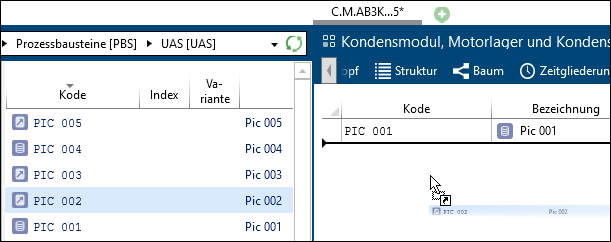
It is advisable to use drag and drop if you want to drag selected rows from a structure into a new structure. Elements can also be inserted into the structure from Explorer using drag and drop. In addition, it is possible to drag an element or a complete tab to a new work area.

Drag & Drop from a tab in the left work area to the right work area
Drag & Drop with data cards
When carrying out analyses with data cards, Drag & Drop can be used to place values in a particular location in an element.

Drag & Drop of a data card
When inserting an element from a data card, the following contents are adjusted:
▪Code
▪Index
▪Variant
▪Description
▪Times (newly evaluated on the basis of the new element and the factors)
Drag & drop of documents
A document can be linked to several elements and can therefore be used with several elements. You can link document elements using drag & drop.
Possible sources for Drag & Drop:
▪Explorer
▪Search
▪Tab Documents of another element
Drag & Drop of a document from Explorer to Document tab
A simple Drag & Drop in the Tab Documents links documents. No copy of the document is created.
Automatic tab change during drag & drop
The automatic tab change can be used when a structure row is to be copied into the structure of a different element using drag and drop. Select the row and drag it to the element into which it is to be inserted. When the mouse cursor is positioned over the target structure tab, the focus changes from the header to the structure tab. The row can then be placed.
Please note: |
|---|
The automatic tab switching also works if a structure line is to be inserted from a tab that is contained in a new window using Drag & Drop. |
Behavior of drag & drop on and between rows
During drag & drop, a distinction is made as to where to insert when inserting several structure lines into a structure.
1.All of the selected rows are then inserted if the source rows are dragged into the target element BETWEEN two rows.
2.If dragged ON TO A row in the target element, this row is overwritten with the first value from the structure lines and all of the other rows expire and are not inserted.
Please note: |
|---|
When dragging and dropping from an element to an existing row in the structure of an element, the structure text is retained if the original default text has been overwritten. Otherwise, the new default text of the new element is displayed. (See: Standard text vs. Structure Text) |