The "EAWS® structure" tab can be activated in all element configurations of the "Process element" element type in the administration if an EAWS® license is available.

"Structure" ribbon of the "EAWS® structure" tab
The tab is used for direct entry of ergonomic data to the structure of the element. All data can be entered as in the EAWS® detailed analysis.
The creation of the EAWS® structure is partially automated. The "Create" button is available for this purpose.
The "Create" button is only active if no EAWS® analysis rows exist. By clicking "Delete", all generated EAWS® structure rows are deleted and the "Create" button becomes active again.
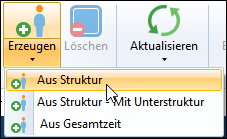
Create button with the options 'From structure' and 'From total time'
Options to create an EAWS analysis:
1.Each structure row is to be assigned to one (or more) EAWS® row(s).
To do this, click on "Create" -> "From structure".
2.If the elements used in the structure already contain EAWS® structures themselves and you want to change their values.
Click "Create" -> "From structure" – "With substructure".
3.If the analysis in the substructure is too small / there are only a few constant loads or you have defined the time duration manually without a structure in time classification.
To do this, click on "Create" -> "From structure".
4.If you want to create the EAWS® structure completely separate from the MTM analysis structure, you can analyze it directly.
It should be noted that the entire time must also be analyzed ergonomically.
The following applies: Total time in the "EAWS® structure" tab = total time of the structure.
 EAWS® structure example based on the structure of the element
|
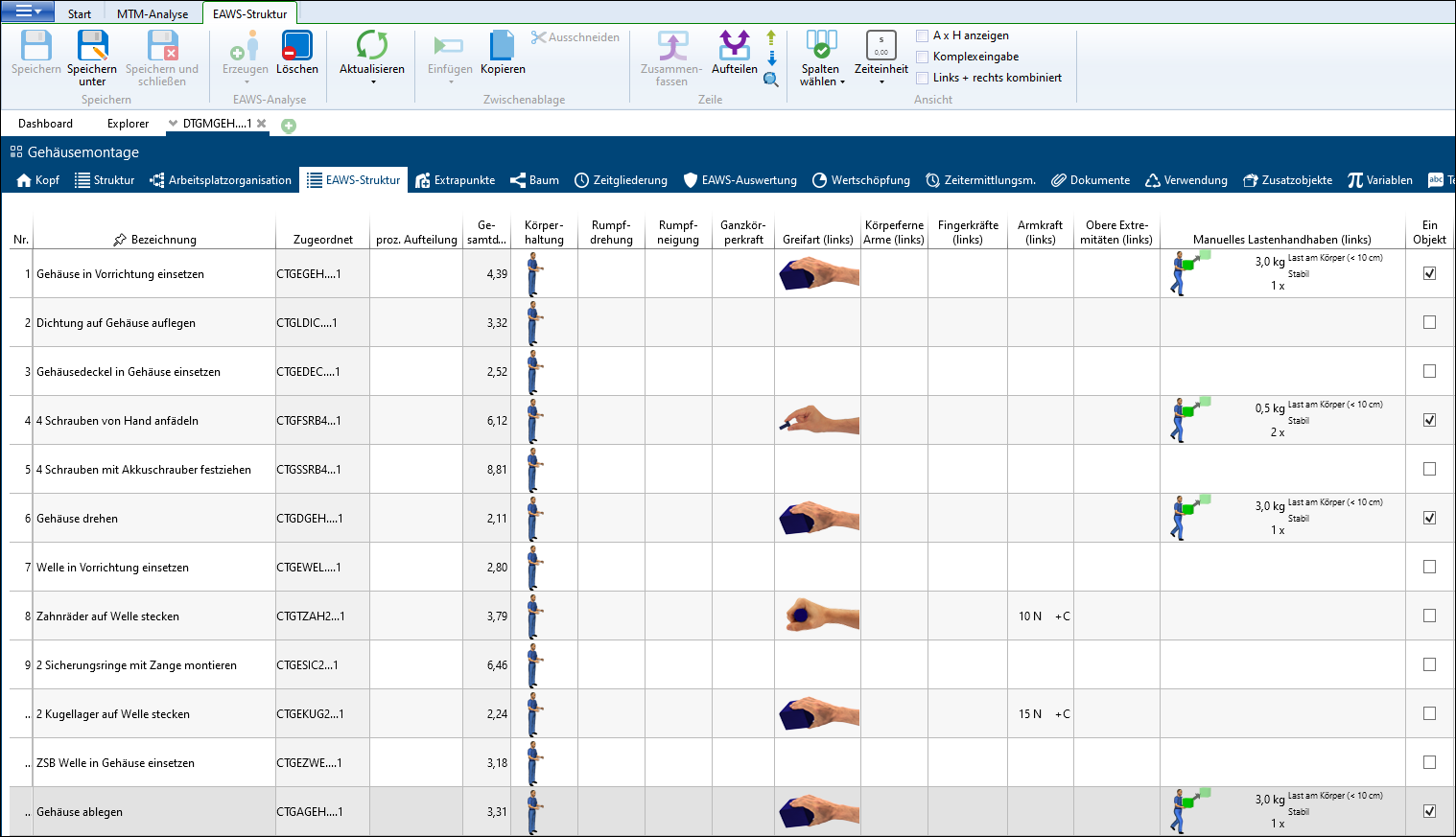
 Option 1: Create from structure
For each process element structure row (elements, text rows, MTM-1® rows), exactly one row is created in the "EAWS® structure" tab that is assigned to this structure row. Description, time, and Q x F are taken from the structure row. Changes (e.g. Q x F) to the process element structure are copied directly into the EAWS® structure. •If a process element is deleted from the structure, it is also removed from the EAWS® structure. •If a process element is inserted, it is also inserted into the EAWS® structure. •If a process element is moved in the structure, this has no influence on the EAWS® structure. You cannot delete or add anything in the "EAWS® analysis" tab. It is only possible to change the order by moving, merge rows, or split them. Characteristics when dividing Q x F into quantity and frequency: TiCon tries to split the factor (Q x F) when creating from the structure in quantity and frequency if the factor matches one of these patterns. 1.Q x F corresponds to (3) * (300/200). There are two recognizable parts that are multiplied. Each part of the two parts is enclosed in brackets or a number (whole number or decimal, no fractions). The first part is the quantity, the second the frequency. 2.Q x F corresponds to (3) * (300/200). 3.Q x F from elements consisting of process times (3000PT*,PT*) are treated as quantity. Frequency = 1. 4.Q x F is just a number (whole number or decimal, no fractions). The number is treated as frequency. Quantity = 1. 5.Everything else like functions (sin, cos, …), multiple brackets (outer brackets), and formulas is treated like a quantity. Frequency = 1. |
Option 2: Create from structure – with substructure
An EAWS® evaluation is also possible when the ergonomic data is not defined by the analysis but by the elements used in the analysis (or its structure).
If the process element from the structure has a defined EAWS® analysis, this is then inserted as a drop down into the "EAWS® analysis" tab. If the process element from the structure does not have a defined EAWS® analysis, a check is performed if its structure elements contain an EAWS® analysis and this is adopted etc. If there is no EAWS® data at any level, a single EAWS® analysis row is created for the entire process element (from the structure). EAWS® analysis rows can also be combined from a substructure. They can only be combined at the same hierarchical level of the same node. |
Option 3: Create from total time
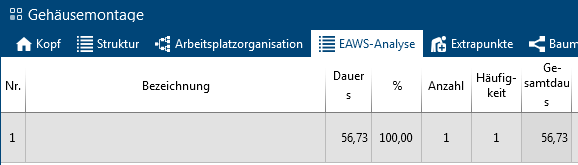
An EAWS® structure row is created to which 100% of the total time (tg) is assigned. Changes to the total time of the element cause the time of the EAWS® structure row to change. Q x F = 1 x 1.
Example of an EAWS® analysis after being created from total time The total time of all EAWS® rows must correspond exactly to the element time. To have more than one EAWS® structure row, the total time can be distributed as a percentage. •tg total of EAWS® structure row = percentage * tg of process element •tg of EAWS® structure row = tg total of row / quantity / frequency --> Quantity and frequency can be changed. The "%" column displays the percentage distribution (0–100). The displayed decimal places depend on the settings in the ribbon. Internally, 15 decimal places are calculated. In contrast to the "Create from structure" function, with "Create from total time" it is possible to create additional EAWS® structure rows using the "New row" button and by pressing the Enter key. By default, the new row has the total time of the process element structure and 100%.
You can delete the rows created in this way at any time by clicking the Delete row button. |
Further functions
Further functions are available in the "Row" area of the ribbon.
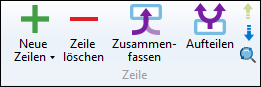
"Row" area in the "Structure" ribbon of the "EAWS® analysis" tab
Several EAWS® structure rows can be combined. To do this, select them and click "Combine" in the ribbon or in the context menu. Basis "Create from structure" •The EAWS® values of the first EAWS® structure row are used. •The assigned process element structure rows of all selected EAWS® structure rows are assigned to the combined EAWS® row (with the respective percentage share; shares of the same process element structure rows are combined). •The description is concatenated and comma separated, i.e. the descriptions of the corresponding process element structure row are used as the description of the EAWS® structure rows. •Code / index / variant are concatenated separated by commas. •Quantity and frequency are taken from the first EAWS® structure row. •tg total of the combined EAWS® row = sum from tg total across all EAWS® rows to be combined •tg total of an EAWS® row = sum across all assigned process element rows from tg total * percentage of structure row •tg = tg total / Quantity / Frequency •Read / Write: tg, tg total from the EAWS® row are read-only; quantity, frequency, percentage (of the process element row) are not If an additional EAWS® structure row is added to a combination, the above rules apply again to the row to be added. 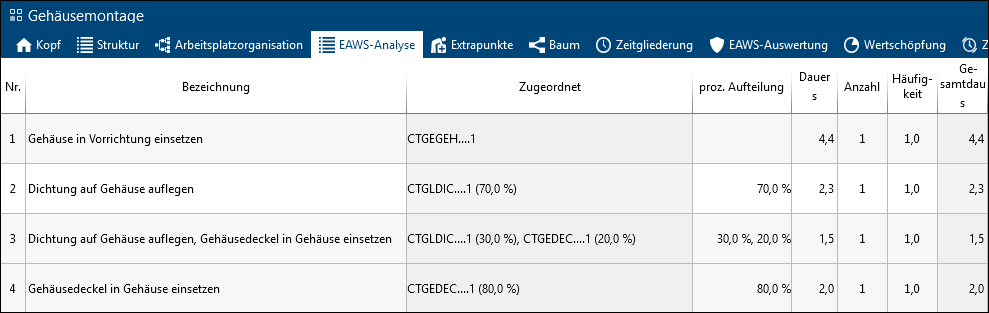 Basis "Create from total time" The EAWS® values of the first EAWS® structure row are used. The new percentage is the sum of the percentage of the combined rows. The description is concatenated. Empty descriptions are ignored. |
It is possible to split one or more EAWS® structure rows. Basis "Create from structure" If more than one process element structure row is assigned to the EAWS® structure row, a 1:1 assignment is generated again, that is, one new EAWS® structure row per process element structure row. If only one process element structure row is assigned to the EAWS® structure row, it is divided by percentage (current distribution / 2) and a new EAWS® structure row is created. 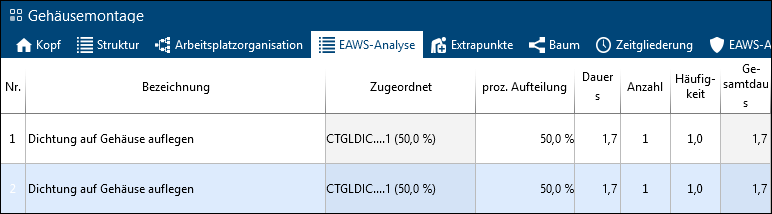 If several EAWS® structure rows are selected, this process is performed for all selected rows. Basis "Create from total time" A new EAWS® structure row is created and the percentage is divided by half. The percentage breakdown can be adjusted in the column %. 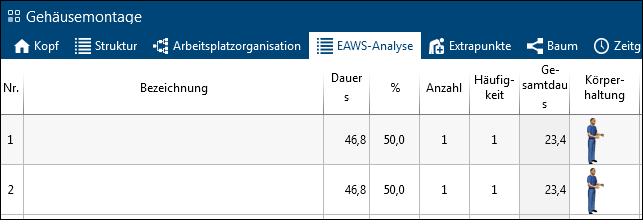 |
Please note: |
•If the structure contains formulas, sections, parallelism, or MTM-1® analyses, it can also be used to perform ergo evaluations. •The brush function can be used to quickly transfer values of individual cells from one row to other selected rows. For details, see “Brush function" •As with the structure of process elements, the temporary subtotal is also shown in the "EAWS® structure" tab in the status bar. |
The "Copy" function is used to copy complete rows (incl. description). The following special features must be observed when inserting: •Insertion into an EAWS® structure created with "Create from structure". Here, only the ergonomics settings are transferred from the source row to the target row. •Insertion into an EAWS® structure created with "Create from total time", or into the EAWS® structure of EAWS® analysis. It is possible to insert the complete row (before/after) into the EAWS® structure. |