 One-handed and two-handed forces
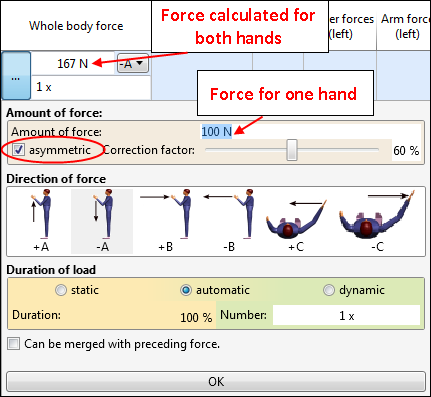
Forces can be weighted one-handed or two-handed. How forces are weighted is explained below. In the EAWS® module in TiCon4, a differentiation is made between the left and right limbs. Forces (finger forces, arm forces) can be entered for both limbs in separate columns. If no force is entered for the left or right hand, the forces are weighted as two one-hand forces. If you should be evaluated as a joint two-hand force, the "One object" checkbox should be activated in the column. Assessment of the arm force is also weighed depending on the mode of grasping, just like the hand and finger forces. A whole-body force is always weighted as a symmetrical (bilateral) force. If this does not reflect the real conditions, the checkmark "Asymmetric" can be enabled in the whole-body force settings. This weights the whole-body force as one-sided force. The force shown in the work contents corresponds to the one-hand force with the correction factor included. It is defined in the "EAWS® Body of Rules" in "Rule 2.9". However, this value represents a recommendation. For this reason the correction factor can be adjusted in EAWS® using the slider.
Whole body force marked as one-sided force (Calculation: 167 N * 60% = 100.2 N ≈ 100 N) |
For forces not to be falsely classified double, the forces of several geometries must be combined into a single force in certain situations. 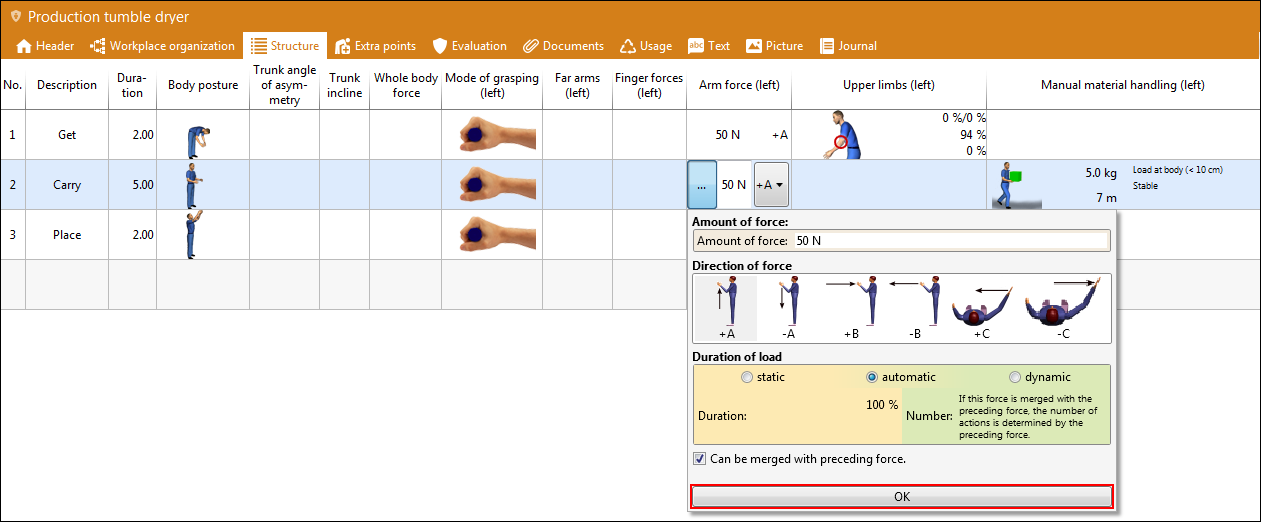 Combining forces into one force The force used in the example of 50 N is therefore not only classified for 5 seconds but 9 seconds (as all three rows are combined) as is also apparent in the evaluation. 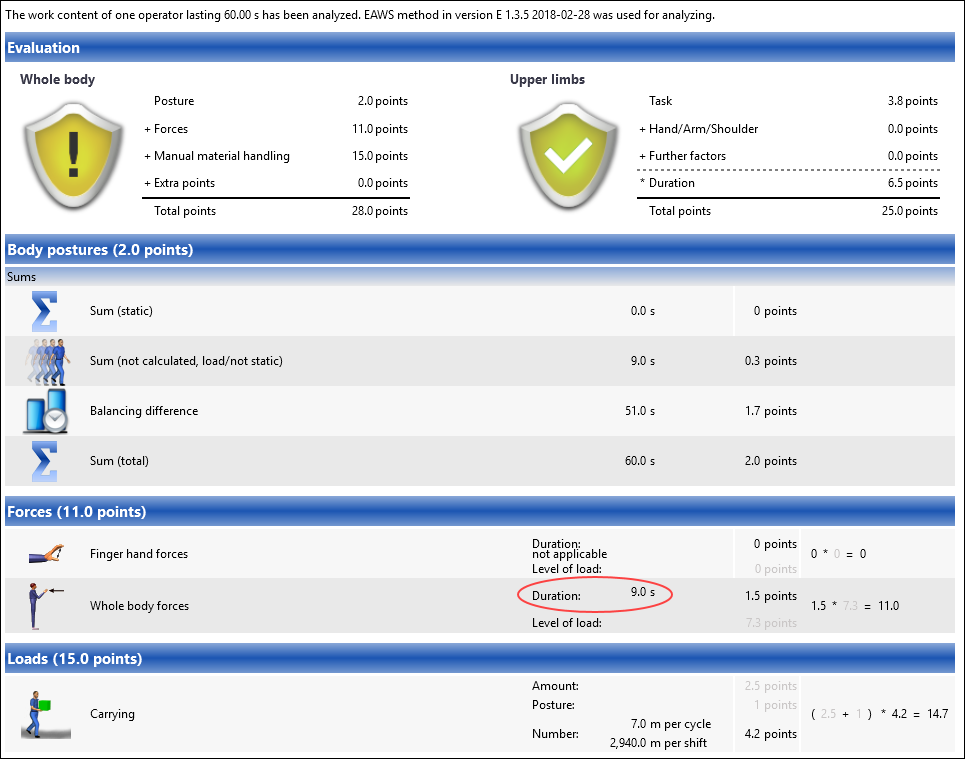 Evaluation view of the above example – duration of the force application: 9 seconds It is enough to enter the amount of force and other influencing factors for the force (e.g. direction of force) in the first row. However, the entries can also be repeated in the subsequent rows for the sake of clarity. A deviation of the forces or loads between the combined lines is recognized by the program and the mean weighted in terms of time is used as calculation basis, as is demonstrated by the following example.  Deviating forces between combined rows (Fmax values based on EAWS® 1.3.6) 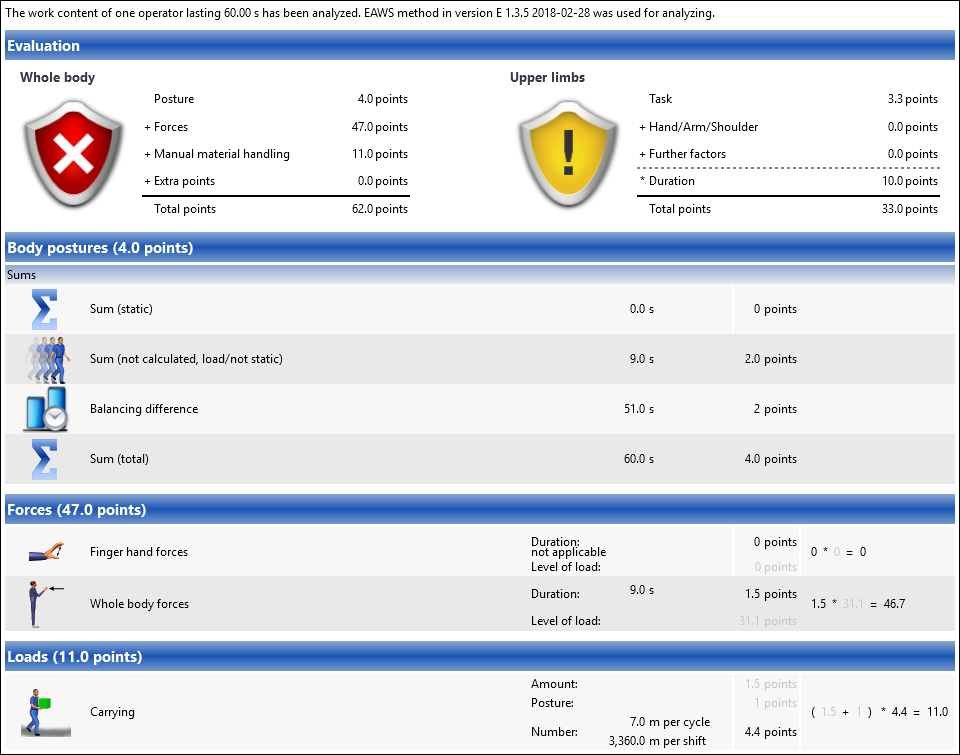 Associated evaluation with whole body force weighted in terms of time |